Share
Here's exactly what to do instead
 ‌ ‌ ‌ ‌ ‌ ‌ ‌ ‌ ‌ ‌ ‌ ‌ ‌ ‌ ‌ ‌ ‌ ‌ ‌ ‌ ‌ ‌ ‌ ‌ ‌ ‌ ‌ ‌ ‌ ‌ ‌ ‌ ‌ ‌ ‌ ‌ ‌ ‌ ‌ ‌ ‌ ‌ ‌ ‌ ‌ ‌ ‌ ‌ ‌ ‌ ‌ ‌ ‌ ‌ ‌ ‌ ‌ ‌ ‌ ‌ ‌ ‌ ‌ ‌ ‌ ‌ ‌ ‌ ‌ ‌ ‌ ‌ ‌ ‌ ‌ ‌ ‌ ‌ ‌ ‌ ‌ ‌ ‌ ‌ ‌ ‌ ‌ ‌ ‌ ‌ ‌ ‌ ‌ ‌ ‌ ‌ ‌ ‌ ‌ ‌ ‌ ‌ ‌ ‌ ‌ ‌ ‌ ‌ ‌ ‌ ‌ ‌ ‌ ‌ ‌ ‌ ‌ ‌ ‌ ‌ ‌ ‌ ‌ ‌ ‌ ‌

*Pre P.S. - I created a quiz to figure out where your leads are falling through the cracks when it comes to sales. Let’s find your relevance gap (it’s free)!


Hey there,


First things first - you’re reading this as I freshly settle into my office post weekend in Los Angeles and Universal (yes, again... you know I love a theme park)


This time I went with my sister and her daughter KT to celebrate her 6th birthday!


It was everything. 🥹🏰✨ 


Now back to your regularly scheduled programming...


Since The Relevance Test dropped last week, my DMs have been full. I’ve been having convos un packing offers, messaging, and lead-to-buyer pipelines.


I’ve been talking in the DMs with quiz takers on:


What people are hearing from leads…

What's stalling…

Where the friction is… 


And what I keep noticing as a common thread between all of them?


A lead drops off, loses interest, says ‘no, not this time’, or ghosts after being a hot lead because of one thing:


A lack of certainty...

  • ...that the offer meets them where they are right now.

  • ...that out of all the offers addressing this issue, you and your offer are best suited to them.

  • ...that they'll be able to get the results (vs previous experiences where they haven't.. either due to their own doing OR program design).


Today I want to unpack objections, through the lens of what the lead is actually saying (so you can pre-handle the REAL reason as early as possible in their journey).


When someone hesitates on your offer, you're probably hearing one of these:


"I need more time."


This one is rarely about time. Something still feels unclear, and they don't know how to name it. Think about it this way, if someone knew with certainty that your offer was going to work for them, they would find the time. They always do. 


The "I need more time" response is almost always a proxy for "I need more clarity." 


Ask yourself, where does the promise get muddy? Where does the process to achieve the outcome feel uncertain? That's where you lost them. Start here in your offer messaging. 


"It's too expensive."


This is almost never about the price itself. It's fear that it won't work for them. Here's the thing about a money objection, if someone knew they were going to spend $5,000 and walk away with $20,000 worth of result, the $5,000 wouldn't feel expensive (even if it technically is in the moment). 


The sticker shock isn't really about the number. It's about the gap between what you're promising and how much they believe it. When someone genuinely believes this was built for their situation and will produce the result they need, the price becomes a lot easier to say yes to. 


"I have to ask my partner."


While this is sometimes true, often, it's permission-seeking while they work out whether they're ready. I've seen this one play out in DMs more times than I can count - someone who is clearly a yes, clearly lit up, clearly needs what's being offered, and then goes quiet behind "I need to run it by my husband." And maybe they do. 


But more often, what's really happening is they haven't fully convinced themselves yet, and asking their partner gives them more time to do that without having to admit the hesitation is internal. They need trust in the offer and clarity on whether they're the right person for it. When your messaging builds that before the conversation starts, the partner conversation becomes a formality, not a deciding factor.


"I'm not sure I'm a good fit."


This one is the most honest of the four. When someone says this, they're telling you something really specific: they cannot find themselves in what you're selling. Not in your case studies, not in your client stories, not in your outcome language. And if the person they see getting results in your world doesn't look like them - different industry, different starting point, different life circumstances - they opt out.


Not because they're wrong for the offer. Because your messaging never showed them someone who looks like them succeeding. That's not a fit problem (despite what they're assuming). That's a proof and positioning problem, and it's one of the most fixable gaps there is.


^These are the four different objections that I see most commonly inside my clients’ businesses. 


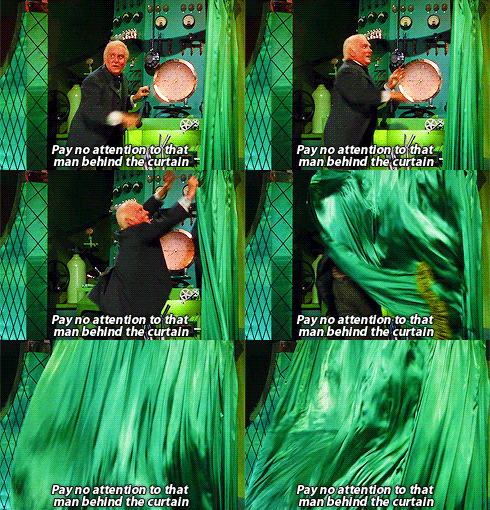
They all say different things, sure. But, I find when you pull back the curtain on any of them you'll find the same thing sitting behind it… 👇


These clarity gaps all come from a buyer who is unable to answer the question "is this actually for me?" 


One person says time because pride won't let them say money


Another says investment because they won't say I don't trust myself to follow through.


~ The surface words are just whatever feels safest to say out loud.~


The words feel different, but the root is identical every single time: they didn't have enough clarity - about the offer, about the outcome, about whether someone like them has done this and won - to feel safe enough to say ‘yes.’


Which is exactly why I teach what I call the A.C.T. framework - and it works in two phases.


Phase one happens in your messaging, before anyone ever objects.


This is where most of the work lives. Your content, your emails, your sales page - these should be doing the heavy lifting long before someone gets to a sales call or your DMs. 


If you want more insight on your BEST place to start optimizing your message, take The Relevance Quiz here.


Phase two is what happens if an objection still surfaces in conversation.


Sometimes a buyer didn't consume all your content. Sometimes they have a deeper, more embedded concern. Sometimes it's a genuinely real-life constraint that just needs a human conversation to untangle. 


That's when A.C.T becomes a live framework - you 

  1. Align (acknowledge without over-validating)

  2. Clarify (ask the open-ended question to better understand the concern they voiced and let them fill the blank) 

  3. Turn (bring the perspective or proof that speaks to what they told you) 


This is the framework I take my clients through ^


Three questions worth sitting with:

  1. Does the structure of your offer actually reinforce the transformation you're promising - or is there a gap between what you deliver and what you can say with genuine conviction?

  2. If a potential buyer asked "will this work for someone like me?" right now - how clearly does your current messaging answer that?

  3. Think about the last few "I need to think about it" responses you received. What specifically felt unclear to them? What did they name? And did your messaging ever actually address it?

If buyers are consistently hesitating, there's a gap somewhere. 


In the positioning, the proof, the messaging clarity - or some combination of all three.


The Relevance Test identifies it in about three minutes. Let’s find where your gap lies!


Take the free quiz, here!

If you'd like to be removed from my email list, just click here


Email Marketing by ActiveCampaign